Trust is the heart of digital identity. If a system cannot tell a real person from a fake one, everything built on top of it becomes shaky. A liveness detection SDK acts like a guard at the door. It checks whether a living person is actually present, keeping printed photos, digital screens and sneaky deepfake clips from slipping past the gate. As online onboarding grows, this layer has turned into a key part of keeping platforms safe.
How a Liveness Detection SDK Secures Modern Verification
Liveness detection studies tiny movements and natural facial behavior that cannot be easily faked. It looks for texture changes, depth clues and lighting reactions that only appear on a real human face. Attackers try creative tricks from masks to high-resolution display screens. The liveness layer catches these the way a sharp-eyed referee spots a foul on the field.
Teams often check public benchmarks to understand how face recognition performs. Resources like the NIST FRVT program and the FRVT detailed evaluation offer deep insight into accuracy, speed and resilience. These reports help developers set realistic expectations for their systems.
Why Liveness Checks Matter for Digital Security
Online platforms face constant attempts at spoofing. Fraudsters try to fool verification systems with printed selfies or well-lit device screens. Liveness checks stop these attempts early, so identity theft does not find an easy path in. A strong liveness layer improves security and keeps users confident that the system protects them.
Key advantages
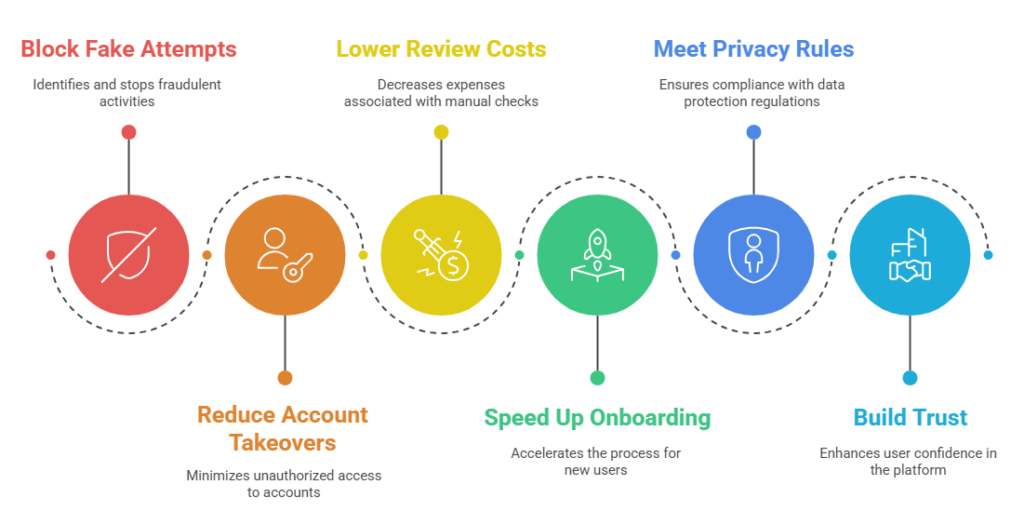
- Blocks fake attempts before they reach matching
- Reduces risk of account takeovers
- Lowers manual review costs
- Speeds up onboarding
- Helps platforms meet privacy rules
- Builds trust in the full experience
If your system serves users in the European region, exploring the GDPR information hub helps you understand how biometric data should be handled responsibly.
How Liveness Fits into the Face Verification Pipeline
The verification workflow behaves like a smooth chain of steps. Liveness appears right at the start. It checks if the user is real. Only then does the image move forward for detection, feature extraction and final matching. This structure keeps the entire system safer and reduces wasted processing.
Workflow overview
| Step | Purpose |
| Capture | Collects the face through the camera |
| Liveness Scan | Confirms the user is real |
| Face Detection | Finds the face in the frame |
| Feature Extraction | Turns facial details into patterns |
| Matching | Compares patterns with stored data |
| Result | Approves or rejects the attempt |
A strong liveness layer cuts down on frustration for real users because fewer legitimate attempts get flagged incorrectly.
Features to Look For When Choosing a Liveness System
Picking the right tool feels like choosing a reliable teammate. You want dependability, speed and the ability to perform well under different conditions. A good system should stay accurate even in challenging lighting or when device quality varies.
Helpful features
- Passive liveness for friction-free experience
- Defense against deepfake videos
- Mobile and web compatibility
- Low processing times
- Easy setup and developer guidance
- Secure data handling practices
- Consistent results across environments
Developers who want to experiment with computer vision can explore this open source vision codebase, which helps teams test ideas and understand model performance.
Trends Shaping Liveness Technology
Artificial intelligence keeps getting smarter and the tools built on it evolve quickly. Passive liveness has become popular because users prefer a natural experience without having to blink or move their heads on command.
Deepfake prevention is also becoming essential. Attackers try to fool systems with AI-generated video. Modern liveness models study tiny distortions and movement gaps that deepfake tools often miss.
Another trend is combining multiple verification layers. Platforms mix document checks, device intelligence and face signals to create stronger protection across the entire journey.
Challenges Developers Face When Adding Liveness
Real world usage brings unpredictable situations. People take verification selfies in cars, hallways, bright sunlight or dim bedrooms. Some move too fast while others hold the camera at tricky angles. These natural variations challenge even the best models.
Processing speed is another concern. Users expect quick results. Developers work with optimized models so even older devices can handle liveness checks smoothly.
Privacy rules in different regions also require careful planning. Being clear about how biometric data is used builds trust and helps companies meet legal expectations.
Case Example of Liveness Boosting Security
A fintech platform once dealt with a surge of fake account attempts. Attackers used printed photos to fool the system. Verification slowed and customer frustration grew. After adding liveness checks, almost all spoof attempts were blocked in the first month. Onboarding became faster and support tickets dropped to a manageable level.
The team joked that the new system was like having a guard with excellent night vision. It caught every suspicious attempt without getting tired. That upgrade protected thousands of users and strengthened overall security.
Best Practices to Get the Most from Liveness Checks
Successful teams follow simple habits that improve system stability.
- Test in varied lighting conditions
- Try multiple device types during evaluation
- Keep instructions friendly and short
- Store biometric data securely
- Benchmark results with public evaluations
- Pair liveness with document checks when risk is higher
These habits help maintain smooth performance even when conditions are unpredictable.
Final Thoughts on Building Trustworthy Face Verification
A liveness detection SDK strengthens the entire identity verification journey. It confirms authenticity, blocks fake attempts and keeps the process simple for real users. With thoughtful setup, privacy awareness and steady testing, teams can build systems ready for the challenges of modern fraud.
Teams who want to explore further can look into helpful tools such as this reliable liveness detection SDK, which supports secure verification and practical integration for face-based systems.
With the right approach, digital identity becomes safer and smoother for everyone who uses it.
Stay in touch to get more updates & news on Xpress Time!